
The Adult Education Teacher Competencies identify the knowledge and skills expected of any adult education teacher to improve student learning and performance. The Competencies also assist in planning professional learning for adult education teachers.
The Adult Education Teacher Competencies Self-Assessment helps adult education instructors determine areas for professional development.
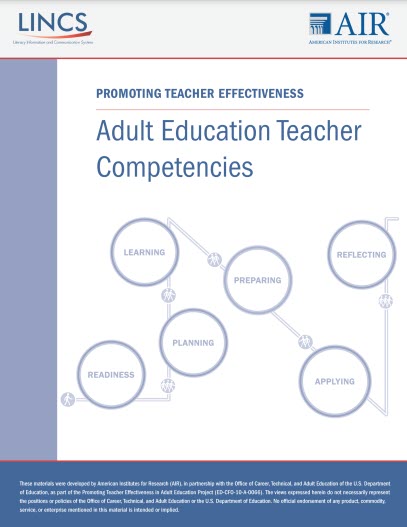
View the domains for Adult Education Teacher Competencies
Domain 1: Monitors and manages student learning and performance through data
1.1. Assesses learners’ prior knowledge, learning needs, and college and career readiness goals
Collects and reviews information on learners’ content knowledge; prior learning experiences; and learning needs from school transcripts, questionnaires, and learner interviews
- Staff Induction Module: Student Intake and Orientation Overview
- Staff Induction Module: Teaching Adult Learners
- Course: Tutor Coordinator Basics
- Course: Evidence-Based Reading Strategies
- Course: Using Assessment to Inform Instruction
- Course: Family Literacy Foundations
Collects and updates information on learners’ goals through interviews and/or questionnaires
- Staff Induction Module: Student Intake and Orientation Overview
- Course: Tutor Coordinator Basics
Reviews the results of program-created and required standardized assessments such as the Tests of Adult Basic Education (TABE), Comprehensive Adult Student Assessment Systems (CASAS), and other assessments
- Course: PA BEST Plus 3.0 Administrator Training
- Course: Tutor Coordinator Basics
- Course: BEST Literacy 2.0 Test Administrator Training
1.2. Sets learning goals and a course of study
Refers to assessments of students’ learning needs and strengths, incoming content knowledge, and prior learning experiences to design courses of study and align learning goals
- Staff Induction Module: Family Literacy Overview
- Staff Induction Module: Writing Lesson Objectives
- Staff Induction Module: Teaching Adult Learners
- Staff Induction Module: Introduction to Standards-Aligned Lesson Planning
- Course: PA TABE 13/14 Training for Partners
- Course: PA TABE 13/14 Administrators Training
- Course: PA CASAS Training for Partners
- Course: PA CASAS for Test Administrators Training
- Course: CCRS Foundations – ELA Lesson Planning
- Course: Using and Scoring ACIRI
- Course: Evidence-Based Reading Strategies
- Course: Using Assessment to Inform Instruction
- Course: Family Literacy Foundations
- Course: CCRS Foundations – Math Lesson Planning
Designs courses of study that link course content to learners’ interests and goals and expose learners to new ideas and experiences that may help them to refine or change their goals over time
- Course: Family Literacy Foundations
- Webinar: Contextualized Teaching and Learning – Friday Lunchtime Webinar – 01-13-2023
Supports students’ continued learning and college and career goals by providing access to advisors and counselors or planning tools
- Course: Tutor Coordinator Basics
1.3. Monitors learning through summative and formative assessment data
Uses a variety of formative assessment tools (such as classroom observations, lesson closure discussions, portfolios, quizzes, and student error logs) to monitor learning and adjust instruction
- Staff Induction Module: Using Assessments to Determine Measurable Skill Gain
- Staff Induction Module: Using Assessment to Inform Instruction
- Staff Induction Module: Teaching Adult Learners
- Course: PA TABE Remote Test Administrator Training
- Course: PA TABE 13/14 Training for Partners
- Course: PA TABE 13/14 Administrators Training
- Course: PA CASAS Training for Partners
- Course: PA CASAS Remote Test Administration Certification
- Course: PA CASAS for Test Administrators Training
- Course: E-LAP and LAP-3 Assessment Implementation
- Course: Using and Scoring ACIRI
- Course: Evidence-Based Reading Strategies
- Course: Using Assessment to Inform Instruction
- Course: Working With English Language Learners: The Role of Formative Assessment
- Course: Family Literacy Foundations
- Webinar: Formative Assessment – Friday Lunchtime Webinar – 12-09-2022
Provides regular, detailed feedback to learners on the progress of their learning
- Course: BEST Literacy 2.0 Test Administrator Training
- Course: Working With English Language Learners: The Role of Formative Assessment
- Webinar: Formative Assessment – Friday Lunchtime Webinar – 12-09-2022
Uses required summative assessments to measure student progress toward learning goals over a specific instructional period and to make decisions about placement and goal-setting in a subsequent instructional period
- Staff Induction Module: Using Assessments to Determine Measurable Skill Gain
- Staff Induction Module: Preparing Students for the High School Equivalency Exam
- Course: PA TABE 13/14 Training for Partners
- Course: PA TABE 13/14 Administrators Training
- Course: PA CASAS Training for Partners
- Course: PA CASAS for Test Administrators Training
- Course: E-LAP and LAP-3 Assessment Implementation
- Course: BEST Literacy 2.0 Test Administrator Training
Assists learners in reflecting on their own performance
- Webinar: Formative Assessment – Friday Lunchtime Webinar – 12-09-2022
1.4. Adapts instruction based on formative and summative student assessment data
Uses formative assessment data to plan a range of supplemental activities for use with learners who struggle to achieve the lesson objectives or who would benefit from an extra challenge
- Customized Course: CCRS Student Work Protocol
- Webinar: Formative Assessment – Friday Lunchtime Webinar – 12-09-2022
Uses diagnostic information from required summative assessments to adapt instruction to reach learners who have difficulty with a particular approach and to deepen learner understanding more generally
- Staff Induction Module: Using Assessment to Inform Instruction
Uses student performance data to make judgments about when and how to diverge from a lesson plan in response to learning needs as they emerge
- Staff Induction Module: Using Assessment to Inform Instruction
- Course: Using Assessment to Inform Instruction
- Course: Working With English Language Learners: The Role of Formative Assessment
- Webinar: Formative Assessment – Friday Lunchtime Webinar – 12-09-2022
Domain 2: Plans and delivers high-quality, evidence-based instruction
2.1. Designs learner-centered instruction and classroom environments
Presents content that connects to learners’ goals and interests and is applicable to their lives
- Course: Motivating Adult Learners to Persist
- Course: ESL Foundations: Classroom Applications for Language Instruction Principles and Theories
- Customized Course: Teaching Skills That Matter in Adult Education
- Course: Reading Instruction Strategies for Beginning ELLs
- Webinar: Contextualized Teaching and Learning – Friday Lunchtime Webinar – 01-13-2023
Establishes a community of practice among learners to encourage peer‐to‐peer learning and a rapport with other students so that they feel encouraged to voice ideas and opinions without fear of negative consequences
- Course: Trauma-Informed Instructional Practices for Adult Educators
- Course: ESL Foundations: Classroom Applications for Language Instruction Principles and Theories
- Customized Course: Teaching Skills That Matter in Adult Education
- Webinar: Making Math Accessible and Equitable Using Number Talks – Friday Lunchtime Webinar – 02-10-2023
Encourages learner self-regulation and metacognition through a variety of skill-building activities to improve learning and overcome difficulties
- Course: Motivating Adult Learners to Persist
- Course: ESL Foundations: Classroom Applications for Language Instruction Principles and Theories
- Webinar: Making Math Accessible and Equitable Using Number Talks – Friday Lunchtime Webinar – 02-10-2023
Provides multiple means and modalities for presenting and engaging learners with concepts, ideas, and materials
- Staff Induction Module: Using the Classroom Toolkit
- Staff Induction Module: Using Assessment to Inform Instruction
- Course: Motivating Adult Learners to Persist
- Course: ESL Foundations: Classroom Applications for Language Instruction Principles and Theories
- Customized Course: Teaching Skills That Matter in Adult Education
- Customized Course: Instructional Routines for Transitioning English Learners
- Course: Reading Instruction Strategies for Beginning ELLs
- Webinar: Making Math Accessible and Equitable Using Number Talks – Friday Lunchtime Webinar – 02-10-2023
2.2. Designs standards-based instructional units and lesson plans
Focuses teaching and learning on a targeted set of standards that builds on their connections to one another
- Staff Induction Module: College and Career Readiness Standards (CCRS) Overview – Math
- Staff Induction Module: College and Career Readiness Standards (CCRS) Overview – English Language Arts (ELA)
- Staff Induction Module: Family Literacy Overview
- Staff Induction Module: Introduction to Standards-Aligned Lesson Planning
- Module: CCRS Key Shifts for Mathematics
- Module: CCRS Key Shifts for English Language Arts
- Module: CCR Standards for Mathematical Practice
- Course: English Language Proficiency Standards Training
- Course: Family Literacy Foundations
- Course: CCRS Foundations – Math Lesson Planning
- Webinar: PA Foundation Skills – Friday Lunchtime Webinar – 04-14-2023
Outlines a clear and explicit standards-based purpose for the lesson, stated in terms of the desired student learning outcomes
- Staff Induction Module: Writing Lesson Objectives
- Staff Induction Module: Introduction to Standards-Aligned Lesson Planning
- Course: CCRS Foundations – ELA Lesson Planning
- Customized Course: Teaching Skills That Matter in Adult Education
- Course: Reading Instruction Strategies for Beginning ELLs
- Course: Working With English Language Learners: The Role of Formative Assessment
- Course: CCRS Foundations – Math Lesson Planning
Designs a coherent sequence and progression of learning so that lessons build on one another, takes advantage of the connections among standards, and permits deep and thoughtful coverage
- Staff Induction Module: Family Literacy Overview
- Module: CCRS Key Shifts for Mathematics
- Module: CCRS Key Shifts for English Language Arts
- Module: CCR Standards for Mathematical Practice
- Course: Evidence-Based Reading Strategies
- Course: CCRS Foundations – Math Lesson Planning
- Staff Induction Module: Preparing Students for the High School Equivalency Exam
- Staff Induction Module: Introduction to Standards-Aligned Lesson Planning
- Course: Teaching With Illustrative Mathematics® Lessons
- Course: CCRS Foundations – ELA Lesson Planning
- Course: Evidence-Based Reading Strategies
- Course: English Language Proficiency Standards Training
- Course: Reading Instruction Strategies for Beginning ELLs
- Course: CCRS Foundations – Math Lesson Planning
- Course: CCRS Foundations – ELA Lesson Planning
- Course: English Language Proficiency Standards Training
- Course: CCRS Student Work Protocol
- Course: Working With English Language Learners: The Role of Formative Assessment
2.3. Uses instructional techniques that are effective with adult learners
Engages students actively in their own learning through relevant, thought-provoking questions, problems, and tasks that stimulate interest
- Course: CCRS Foundations – ELA Lesson Planning
- Course: ESL Foundations: Classroom Applications for Language Instruction Principles and Theories
- Customized Course: Teaching Skills That Matter in Adult Education
- Customized Course: Instructional Routines for Transitioning English Learners
- Course: CCRS Foundations – Math Lesson Planning
- Webinar: Contextualized Teaching and Learning – Friday Lunchtime Webinar – 01-13-2023
- Webinar: Making Math Accessible and Equitable Using Number Talks – Friday Lunchtime Webinar – 02-10-2023
Varies instructional activities and examples to improve conceptual understanding and skill development
- Course: Reading Instruction Strategies for Beginning ELLs
- Customized Course: CCRS Student Work Protocol
- Course: CCRS Foundations – Math Lesson Planning
- Webinar: Making Math Accessible and Equitable Using Number Talks – Friday Lunchtime Webinar – 02-10-2023
- Webinar: Standards in Action for English Learners – Friday Lunchtime Webinar – 03-10-2023
Addresses diverse learning modalities, abilities, needs, and interests through differentiated instruction
- Staff Induction Module: Using the Classroom Toolkit
- Staff Induction Module: Teaching Adult Learners
- Course: Trauma-Informed Instructional Practices for Adult Educators
- Course: Motivating Adult Learners to Persist
- Course: ESL Foundations: Classroom Applications for Language Instruction Principles and Theories
- Customized Course: Teaching Skills That Matter in Adult Education
- Customized Course: Instructional Routines for Transitioning English Learners
- Course: Evidence-Based Reading Strategies
- Course: English Language Proficiency Standards Training
- Course: Reading Instruction Strategies for Beginning ELLs
- Course: CCRS Foundations – Math Lesson Planning
- Webinar: Instructional Strategies for Reading – Friday Lunchtime Webinar – 10-14-2022
- Webinar: Making Math Accessible and Equitable Using Number Talks – Friday Lunchtime Webinar – 02-10-2023
- Webinar: Standards in Action for English Learners – Friday Lunchtime Webinar – 03-10-2023
Provides various opportunities for classroom interaction, where learners are grouped with others with a range of same-to-different needs, interests, and abilities, as well as opportunities for individual work, when appropriate
- Course: ESL Foundations: Classroom Applications for Language Instruction Principles and Theories
- Customized Course: Teaching Skills That Matter in Adult Education
- Webinar: Standards in Action for English Learners – Friday Lunchtime Webinar – 03-10-2023
Uses explicit instruction in instructional design to set a purpose for learning that is clear to the learner, breaks down content into smaller parts that follow a logical sequence, includes modeling, and provides immediate feedback to learners
- Course: CCRS Foundations – ELA Lesson Planning
- Course: ESL Foundations: Classroom Applications for Language Instruction Principles and Theories
- Course: Evidence-Based Reading Strategies
- Course: Working With English Language Learners: The Role of Formative Assessment
- Webinar: Instructional Strategies for Reading – Friday Lunchtime Webinar – 10-14-2022
- Webinar: Supporting Writing Strategies Virtually and In Person – Friday Lunchtime Webinar – 05-12-2023
Designs instruction within the course content that targets specific skills, such as active listening, notetaking, skimming and scanning, formal writing, effective communication, and study habits, to encourage learner development
- Webinar: Standards in Action for English Learners – Friday Lunchtime Webinar – 03-10-2023
- Webinar: Supporting Writing Strategies Virtually and In Person – Friday Lunchtime Webinar – 05-12-2023
2.4. Designs instruction to build learners’ technology and digital media literacy skills
Demonstrates the value of technology to stimulate learning, pique interest, and provide opportunities to apply ideas and concepts to learners’ daily lives
- Staff Induction Module: Introduction to Standards-Aligned Lesson Planning
Provides appropriate hands-on opportunities for learners to interact with computers, the internet, and other digital media on a regular basis, from basic operations to more sophisticated ones, in order to build technology literacy skills
- Customized Course: Teaching Skills That Matter in Adult Education
Provides tasks and projects within the course content that require technology for research, presentation, data management, and other skills
- Customized Course: Teaching Skills That Matter in Adult Education
- Course: CCRS Foundations – Math Lesson Planning
- Webinar: Supporting Writing Strategies Virtually and In Person – Friday Lunchtime Webinar – 05-12-2023
Teaches critical analysis and evaluation strategies of web-based information and digital media, including an understanding of authenticity, agenda, purpose, and point of view
2.5. Designs instruction to build learners’ higher-order thinking, communication, and problem-solving skills
Provides activities that require suspending judgment, coming to consensus, discussing alternatives, prioritizing, negotiating, problem-solving, evaluating, and other skills
Provides opportunities for inquiry and for learners to construct meaning and develop ideas from open-ended questions
- Customized Course: Instructional Routines for Transitioning English Learners
- Webinar: Standards in Action for English Learners – Friday Lunchtime Webinar – 03-10-2023
Provides learners opportunities to apply their knowledge, skills, and new learning to identify obstacles and solutions to real-life and classroom projects through independent and collaborative problem-solving activities
- Customized Course: Teaching Skills That Matter in Adult Education
Domain 3: Effectively communicates to motivate and engage learners
3.1. Communicates high expectations of learners and motivates them to persist to meet their goals
Communicates learning goals and explains to learners in clear language how day-to-day instruction, assignments, and projects support them in achieving those goals
- Course: Trauma-Informed Instructional Practices for Adult Educators
Encourages learners to ask questions and seek out help when they are experiencing difficulty
- Staff Induction Module: Using the Classroom Toolkit
Builds learner confidence by providing feedback on progress in relationship to learning goals and encouragement and clear feedback about the steps needed to continue moving toward goal attainment
- Course: Working With English Language Learners: The Role of Formative Assessment
3.2. Communicates in a clear and understandable way
Speaks and writes clearly and accurately when giving directions for tasks, clarifying content, questioning, and evaluating student work and ideas
- Course: Reading Instruction Strategies for Beginning ELLs
- Course: CCRS Student Work Protocol
Uses language and notation that is appropriate for learners, based on their backgrounds and abilities
- Staff Induction Module: Teaching Adult Learners
- Course: Reading Instruction Strategies for Beginning ELLs
- Webinar: Asset-Based and Inclusive Language and Culturally Responsive Teaching – Friday Lunchtime Webinar – 09-09-2022
Selects level-appropriate materials and presents them in an understandable and organized format to support the goals of the lesson
- Course: Reading Instruction Strategies for Beginning ELLs
- Customized Course: CCRS Student Work Protocol
3.3. Engages in active listening, dialogue, and questioning to facilitate and support learning
Uses questioning strategies for understanding and responding to student comments and questions in order to engage learners in inquiry, challenging their own assumptions, and problem-solving
Builds stop, reflect, and check-in points in lesson plans to provide learners with opportunities to clarify, confirm, or deepen their understanding of the lesson task or content
- Customized Course: Teaching Skills That Matter in Adult Education
3.4. Models an understanding of diversity
Uses diversity of learners’ home languages, cultures (ethnic, racial, sexual, religious, class based) and prior language/literacy learning experiences as a resource for learning and building a classroom
- Staff Induction Module: Family Literacy Overview
- Course: ESL Foundations: Classroom Applications for Language Instruction Principles and Theories
When evaluating learner performance, tailors feedback based on an understanding of linguistic, cultural, and ability differences, such as when learners are members of vernacular-speaking communities, are second language learners, or possibly have learning difficulties
- Course: Reading Instruction Strategies for Beginning ELLs
Uses language and chooses classroom materials that respect learners’ identities as individuals
- Course: ESL Foundations: Classroom Applications for Language Instruction Principles and Theories
- Webinar: Asset-Based and Inclusive Language and Culturally Responsive Teaching – Friday Lunchtime Webinar – 09-09-2022
Teaches critical analysis and evaluation strategies of web-based information and digital media, including an understanding of authenticity, agenda, purpose, and point of view
Domain 4: Pursues professionalism and continually builds knowledge and skills
4.1. Possesses content area knowledge and teaching skills required for subjects and populations taught
Demonstrates knowledge of subjects and populations taught through the development of lesson plans, activities, and a selection of resources that have evidence of effectiveness and are aligned with instructional goals and standards
- Course: Teaching With Illustrative Mathematics® Lessons
- Course: CCRS Foundations – ELA Lesson Planning
- Course: Evidence-Based Reading Strategies
- Course: English Language Proficiency Standards Training
- Course: Reading Instruction Strategies for Beginning ELLs
- Course: Family Literacy Foundations
Builds knowledge and skills both in content areas and pedagogy through formal education, preservice learning, job-embedded learning, or participation in professional development activities
- Staff Induction Module: College and Career Readiness Standards (CCRS) Overview – Math
- Module: CCRS Key Shifts for Mathematics
- Module: CCRS Key Shifts for English Language Arts
- Module: CCR Standards for Mathematical Practice
- Tutor Training Module: Preparing Students for the High School Equivalency Exam
Evaluates areas where one’s own pedagogical and/or content knowledge needs to be strengthened and seeks out professional development settings and resources to address these needs as part of a professional development plan
- Course: English Language Proficiency Standards Training
- Staff Induction Module: Using the Adult Education Teacher Competencies
Connects professional learning to instructional practice by implementing what has been learned, evaluating the impacts, and refining practice going forward
- Staff Induction Module: College and Career Readiness Standards (CCRS) Overview – Math
- Course: Trauma-Informed Instructional Practices for Adult Educators
- Course: Teaching With Illustrative Mathematics® Lessons
- Course: Tutor Coordinator Basics
- Course: CCRS Foundations – ELA Lesson Planning
- Customized Course: Teaching Skills That Matter in Adult Education
- Customized Course: Instructional Routines for Transitioning English Learners
- Course: English Language Proficiency Standards Training
4.2. Participates in professional development networks and learning communities
Participates regularly in a professional learning network or community of practice, with the express purpose of improving teaching and writing
- Customized Course: Instructional Routines for Transitioning English Learners
- Customized Course: CCRS Student Work Protocol
Shares content and pedagogical resources with program staff in collaborative professional development projects
- Customized Course: Teaching Skills That Matter in Adult Education
- Customized Course: CCRS Student Work Protocol
Participates in the development and implementation of a shared vision among members of a professional network or learning community, with the intent of creating new and improved conditions for teachers and learners
- Course: Tutor Coordinator Basics
Shares, gives, and accepts feedback related to student learning through professional networks and learning communities
- Customized Course: Peer Observation
- Customized Course: CCRS Student Work Protocol
4.3. Refines instructional practices through reflection on experience, evidence, and data
- Customized Course: CCRS Student Work Protocol
Understands the nature and purpose of teacher reflection tools (e.g., teaching journal/diary, self-observation, action research) and uses these tools in response to the local teaching context
- Staff Induction Module: Using the Adult Education Teacher Competencies
- Course: English Language Proficiency Standards Training
- Course: CCRS Foundations – Math Lesson Planning
- Customized Course: Peer Observation
Regularly seeks out opportunities to tap into current professional wisdom, empirical research, and theory as a vehicle for reflecting on and improving one’s own teaching
- Course: ESL Foundations: Classroom Applications for Language Instruction Principles and Theories
4.4. Participates in and contributes to program improvement efforts
Routinely shares instructional plans, data, and reflections on learner progress with other program staff members
Identifies patterns in learner achievement to suggest program-wide changes in course structure, content, pedagogy, or professional development
Identifies patterns in learners’ academic and career goals to suggest program-wide changes in advising and contextualized instruction and to encourage collaboration with higher education, industry, and other institutions